
Your Cart is Empty
💫 LIMITED OFFER: Buy 2 JEWELRY ITEMS, GET 3RD FREE (AUTOMATIC DISCOUNT)
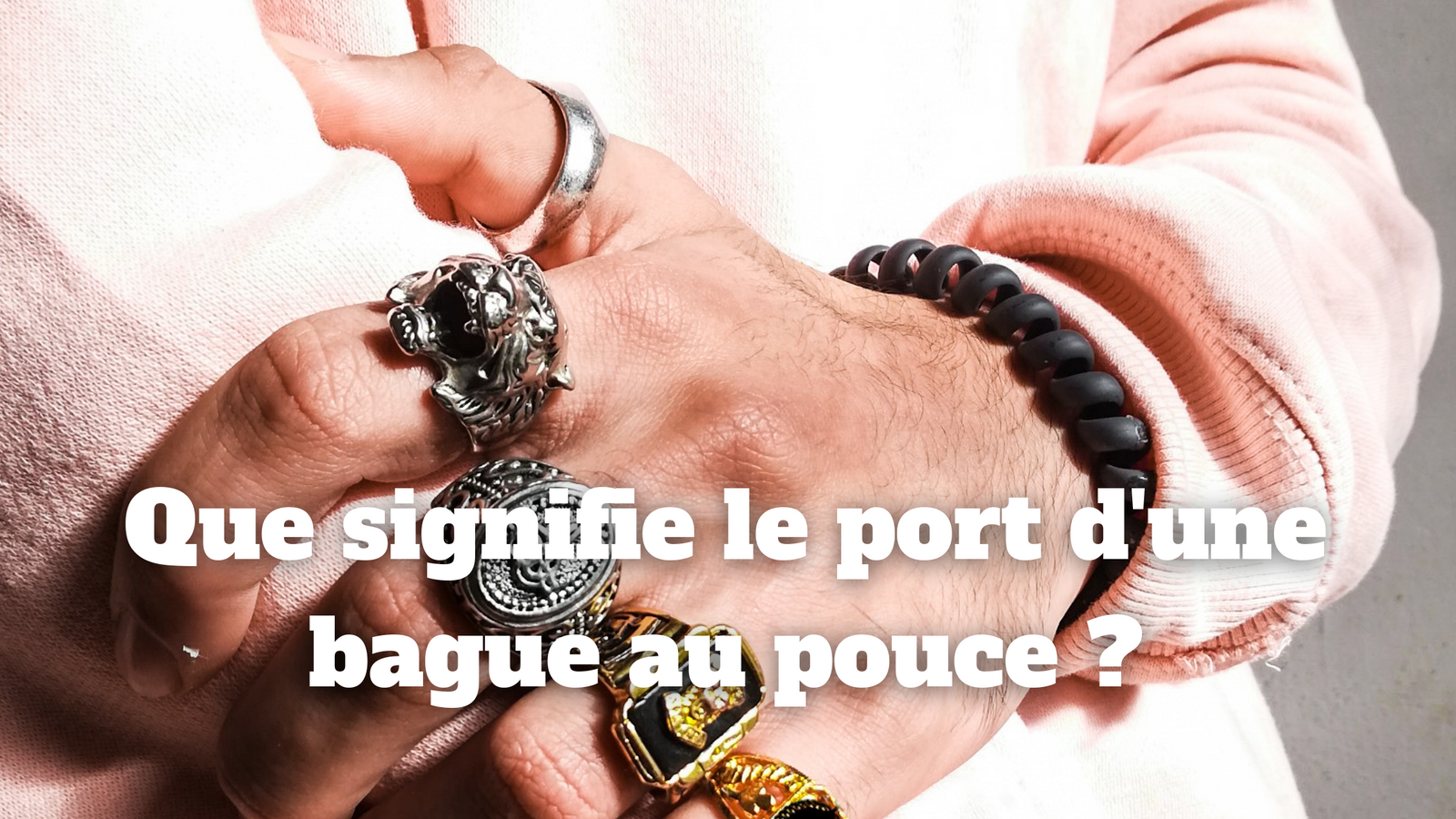

Wearing a ring on your thumb has a very particular, symbolic meaning. First, a thumb ring has long been seen as a mark of social distinction, worn to show that the person has reached a certain status or level of success. It is also a symbol of independence and freedom: the thumb is the finger that works on its own, apart from the others, so a ring there expresses the feeling of being in control of your own destiny. Finally, a thumb ring can be read as a sign of strength, confidence and natural leadership.
The thumb is the strongest finger of the hand, which is why a thumb ring is often associated with willpower, power and assertiveness. In some cultures, it was also worn as a protective talisman, believed to ward off bad luck and the evil eye and to bring good fortune to the wearer. Today, many people wear a thumb ring as a reminder of a personal commitment, as a sign of self-confidence, or simply to show off their personal style and individuality. Whatever it means to you, a thumb ring is a unique way to express who you are.
There is no official rule: you can wear a ring on your left thumb or your right thumb. According to the most common interpretations, the side you choose adds a nuance to the message:
In practice, most people simply choose the side where the ring bothers them the least day to day.
For women, a thumb ring is above all a statement piece. The thumb is not the finger for wedding or engagement rings, so wearing a ring there is a personal choice that follows no convention. That is why it is often associated with independence, self-confidence and a personality that owns its style.
It is also a real fashion accessory: a thin ring on the thumb balances a hand that already wears several rings, especially with the stackable ring trend.
For men, a thumb ring has traditionally evoked status and authority. In the Middle Ages and the Renaissance, European noblemen wore wide thumb rings, sometimes signet rings, to display their rank. Today, a chunky steel or silver thumb ring mainly gives a bold look that is easy to pair with a chain bracelet or a watch.
One of the oldest origins of the thumb ring is practical: in Asia, among the Mongols, in China and in the Ottoman Empire, archers wore a ring on their thumb to draw their bowstring without hurting themselves. These archer's rings, made of bone, jade, horn or metal, later became prestige items worn by the elite, far beyond archery. To discover other traditions, read our article on jewelry symbolism across cultures.
To find your ring, browse our collection of chain rings or, for men, our selection of men's rings.
Not necessarily. It is often linked to independence, self-confidence or status, but most people simply wear one because they like it. Its meaning mostly depends on the one you give it.
You will need a much larger size than for your ring finger or index finger. Measure both the base of your thumb and your knuckle, and go with the larger measurement so the ring can slide on.
No. As with any ring, just avoid one that is too tight, and take it off for sports, DIY or if your fingers swell.
A plain band on the thumb has the same meaning as any thumb ring: self-assertion, independence or simply a style choice.
Comments will be approved before showing up.